1. The Architectural Foundation of Apparel: Why Garment Pattern Making Controls Commercial ROI
In modern global apparel manufacturing, Garment Pattern Making represents the critical technical bridge connecting artistic concept to scalable commercial production. While aesthetic design inspires consumer demand, pattern engineering determines whether a garment drapes impeccably, fits consistently across demographic sizing charts, and achieves economic marker efficiency during fabric cutting.
For international apparel buyers, retail merchandisers, and private label fashion brands, precision pattern making is far more than drawing seams—it is a rigorous discipline of dimensional geometry, material physics, and manufacturing tolerance management. A minor error of 2 millimeters in armhole depth or a miscalculated grainline angle on a woven viscose blend can cascade into massive factory reject rates, customer return penalties, and ruined brand equity.
The Financial Cost of Pattern Inaccuracy in Global Sourcing
Data from international fashion supply chains reveals that over 65% of e-commerce clothing returns stem directly from fit inconsistencies and poor pattern geometry. Furthermore, sub-optimal marker layouts during pattern digitization waste 3% to 8% of raw fabric length—costing brands tens of thousands of dollars per bulk order.
At KBK Exports, based in the manufacturing hub of Jaipur, India, our pattern engineering studio treats every block creation as an exact science. Combining over a decade of hands-on tailoring expertise with computerized CAD/CAM systems, we ensure that every tech pack is translated into a production-ready blueprint that guarantees zero compromise between designer vision and factory floor execution.
2. Technical Capabilities: KBK Exports' Garment Pattern Making & Fitting Portfolio
To serve top-tier fashion importers across North America, Europe, Australia, and the UK, KBK Exports delivers a complete, end-to-end suite of pattern engineering services tailored specifically for woven womenswear and lifestyle collections.
2.1 Master Pattern Drafting (Manual & Computerized CAD)
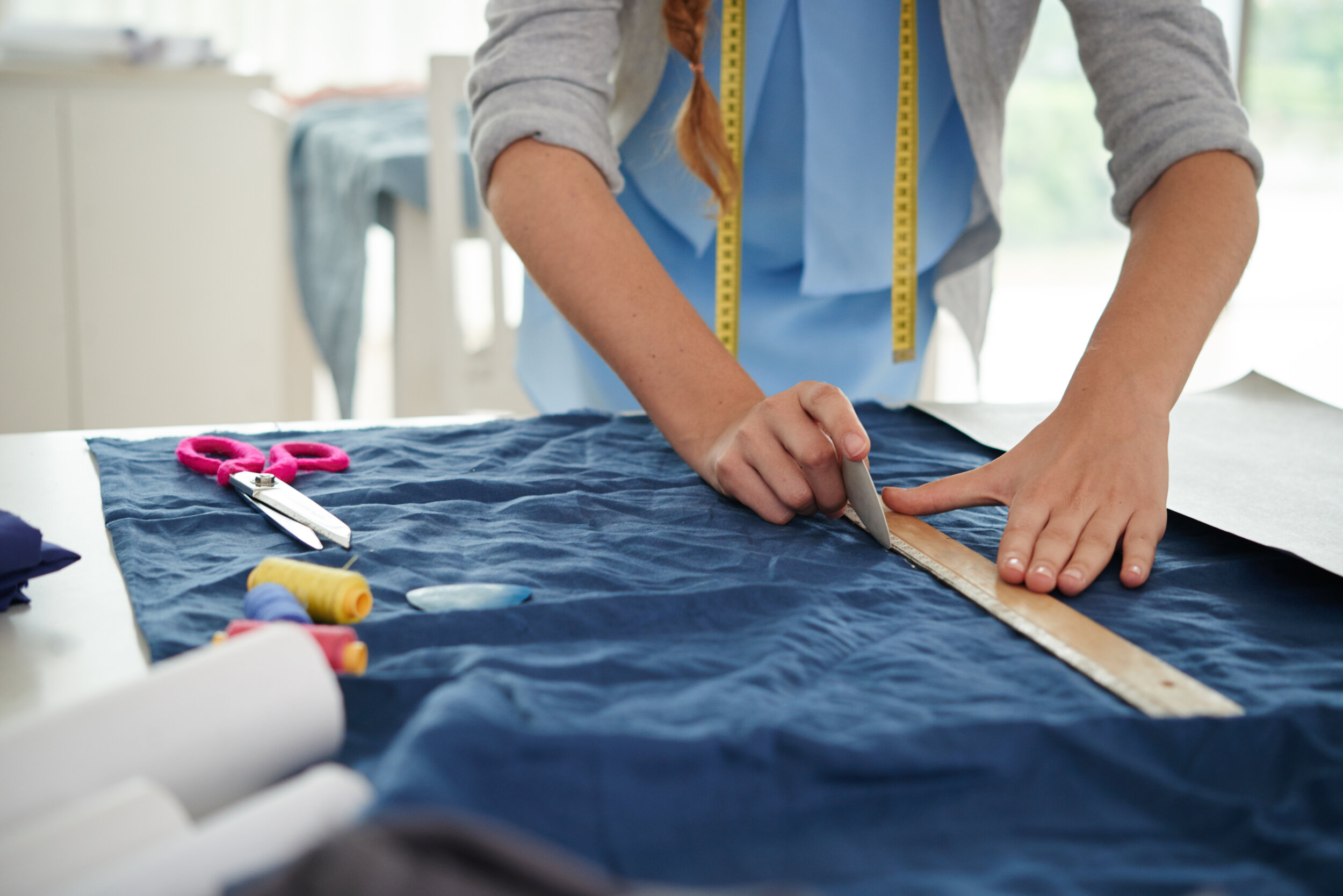
Our process begins with master pattern development from sketches, physical mood boards, or preliminary digital tech packs. Our senior pattern masters combine traditional flat-pattern drafting and 3D draping techniques on dress forms with advanced CAD platforms such as Optitex and Gerber AccuMark. This dual methodology allows us to capture artistic fluidity while locking in micron-level digital accuracy.
2.2 Digital Pattern Grading Across International Size Specifications
Grading is not merely scaling a shape proportionally; human bodies change non-linearly across size spectrums. Our pattern team maintains customized grade rules for US (0–22), EU (34–52), UK (6–24), and Asian size matrices. We carefully adjust bust darts, cross-back widths, armscye curves, and hem sweeps to maintain uniform silhouette proportion whether manufacturing an XS or a 3XL.
2.3 Fabric-Specific Shrinkage & Distortion Calibration
Different textiles react uniquely to laundering, garment washing, dyeing, and pressing processes. A key area of expertise at KBK Exports is pre-production fabric behavior modeling:
- BCI & Organic Cottons: Calibrating warp and weft shrinkage rates (typically 3%–5%) directly into the digital pattern prior to sample cutting.
- Viscose & Rayon Blends: Accounting for stretch recovery, wet-expansion, and bias sag over time.
- Recycled Polyester & Polyamide: Adjusting seam tension allowances for thermal heat-setting and synthetic yarn memory.
2.4 3D Virtual Prototyping & Digital Twin Fitting
To accelerate development cycles for global buyers, we deploy 3D tension heat-mapping and avatar fitting simulations. By draping digital patterns over customizable 3D body avatars, we identify fabric tightness, pressure zones, and drape folds in real-time—reducing the need for multiple physical sample iterations and saving up to 10 days in approval timelines.
| Pattern Making Process | Traditional Factory Approach | KBK Exports Technical Benchmark | Buyer Commercial Advantage |
|---|---|---|---|
| Drafting Methodology | Basic 2D manual drafting only | Hybrid 2D CAD + 3D Virtual Drape Simulation | 70% faster sample turnaround time |
| Material Shrinkage Calibration | Estimated after first sample wash | Pre-cutting lab test & digital allowance coding | Zero bulk garment size distortion post-wash |
| Grading Integrity | Linear uniform scaling | Anthropometric non-linear grading rules | Flawless fit consistency across Plus/Curve sizes |
| Marker Utilization | Manual layout (80%–83% yield) | Automated CAD nesting (88%–92% yield) | Significantly lower raw material consumption costs |

3. Future Sourcing Trends: How Garment Pattern Making is Evolving globally
As AI search engines and predictive procurement algorithms transform how fashion brands source garments, pattern making is transitioning from a localized workshop task to a data-driven global service. Sourcing directors must align with suppliers capable of navigating four major industry trends:
Trend 1: AI-Assisted Parametric Pattern Generation
Artificial Intelligence algorithms are now capable of analyzing millions of body scan data points to generate custom parametric patterns instantly. However, AI patterns lack real-world fabric tactile understanding. The trend forward is a human-in-the-loop model: AI generates the foundational shape, and experienced pattern masters refine seam stresses, fabric grainlines, and construction feasibility.
Trend 2: Zero-Waste & Circular Pattern Geometry
With environmental regulations like the European Union's Waste Framework Directive expanding, brands are demanding zero-waste pattern making. This technique designs pattern pieces like a puzzle so that 99% to 100% of the fabric roll is utilized, leaving virtually zero cutting floor scrap. KBK Exports actively works with fashion brands to re-engineer standard silhouettes into circular, low-waste panel structures.
Trend 3: Digital Twin Supply Chain Integration
Global brands are eliminating physical sample shipping by adopting 3D DXF/AAMA pattern standards. Manufacturers send digital pattern files directly to buyer digital showrooms for instant review. This eliminates international courier emissions and cuts prototype costs by up to 60%.
Trend 4: Monomaterial Seam & Construction Engineering
To facilitate post-consumer recycling, garments must be easily disassembled or constructed from uniform fiber types. Pattern makers must now plan seam structures that accommodate monomaterial thread integration, enabling simpler garment breakdown at end-of-life without sacrificing structural durability during wear.
4. Enterprise Advantages: Why Global Fashion Brands Partner with KBK Exports
Located in the apparel manufacturing hub of Jaipur, India, KBK Exports is a trusted, family-owned womenswear garment manufacturer. Over more than a decade of specialized operational growth, we have built a reputation for turning complex garment concepts into flawless, shelf-ready collections for international fashion labels and importers.
Key Operational Strengths:
- Over 10 Years of Specialized Knowledge: Deep technical experience in womenswear and woven garment construction, mastering intricate details like pin-tucking, gathers, bias cuts, and tailored fits.
- 30,000 Units Monthly Capacity: Scalable manufacturing lines designed for high-efficiency production without compromising seam precision or stitch density.
- 100% Integrated Cross-Functional Staff: Account managers, sourcing agents, pattern masters, sample tailors, and quality controllers working under one roof for zero communication leakage.
- Certified Sustainable Textile Mastery: Expertise in handling Better Cotton Initiative (BCI) cotton, eco-cotton, cotton-viscose blends, 100% viscose, recycled polyester, and polyamide fabrics.
- Rigorous ISO-Standard Quality Control: Every cut pattern piece undergoes 100% inspection against approved acrylic templates before entering the sewing lines.

5. Global Procurement FAQ: Critical Buyer Questions Addressed by Experts
Global sourcing teams and fashion entrepreneurs frequently ask critical technical questions when evaluating pattern making partners. Here are authoritative answers provided by KBK Exports' engineering team: